Showing posts with label Gayatri Mata. Show all posts

Friday, 5 August 2011

Gayatri and Sandhyaa

Gayatri Mantra and Sandhyaa By Sushma Gupta
[Taken from "US Brahmins" Group, Mar 5, 2011]
It is said that if for three generations people do not perform Gayatri Jap (Chanting) properly, even the so-called priestly class, will get downgraded. Even if somebody has to leave his home for work early and cannot perform it daily, he should do  it 1008 times at least on Sundays and other holidays. "Sahastra Paramaa Devee shat madhyaa dashaavara", says the Taitteerya Aranyak of Yajur Ved. It means chanting Gayatri 1008 times gives the best result, chanting 108 times gives mediocre results while chanting ten times Gayatri gives the lowest results.
It is also said that best results of chanting Gayatri are obtained by chanting in early morning, noon and evening twilight . Chanting during these three Sandhyaa Kaal are stated to confer on us tranquility and peace. It is also said that whatever may be the emergency, at least 10 Gayatri should be chanted in these time periods. This should not be interpreted to mean that it is sufficient to chant only 10 Gayatri even when we have all the time for doing Gayatri Japam, rather we should always try to do maximum, if we can.
In the morning Gayatri is to be meditated as Brahm Roopinee, in midday as Shiv Roopinee and in the evening as Vishnu Roopinee. Again, Gayatri is also meditated as Savitri in noon and Saraswatee in the evening. When a Braahman boy undergoes Upanayan (investiture of sacred thread), his Aachaarya tells him to perform Sandhyaa Vandan and Gayatri Jaap thee times a day. In the morning 108 Gayatri are to be performed, 32 at noon and 64 in the evening.
They must not eat unclean food, go to unclean places and must atone for lapses in ritual observances and in maintaining ritual purity. Henceforth they must take every care to see that their body is kept chaste and fit for it to absorb Mantrik power. Even in times of misfortune the Gayatri must be muttered at least ten times at dawn, midday and dusk, because these are the hours of tranquility. One must take up the Gayatri Jap as Vrat (vow).
Gayatri Jap and "Arghya" (offering libation) are the two most important rites of Sandhyaa Vandan. The other parts of this rites are "Ang" (limbs). The least a sick or weak person must do us to offer Arghya and mutter the Gayatri ten times. "Oh only these two are important aren't they? So that's all we do, offer Arghya and mutter the Gayatri ten times a day."
If this be our attitude, in due course, we are likely to give up even these that are vital to Sandhyaa Vandan. A learned man remarked in jest about the people who perform Arghya and mutter Gayatri only ten times thus applying to themselves the rule meant for the weak and the unfortunate, "They will always remain weak and be victims of some calamity or other". Sandhyaa Vandan must be performed properly during right hours. During the Mahaabhaarat war, when water was not readily available, the warriors offered Arghya at the right time with dust as substitute. Arghya must be offered before sunrise, at noon, and at sunset.
Only by the intense repetition of Gayatri shall we be able to master all the Vaidik Mantra. This Jap of Gayatri and Arghya must be performed everyday without fail. Even if a man is very sick to do Sandhyaa Vandan, people must pour the water with which Sandhyaa Vandan has been performed into his mouth. Gayatri is essential to the self and its Jap must not be given up at any time. It is more essential to your inner being than medicine is to your body. Sandhyaa Vandan must be performed without fail everyday. Gayatri Jap can be done by all of us without much effort and without spending any money. All that you require is water. Sandhyaa Vandan is indeed an easy means to ensure your well being. So long as there is life in you, you must perform it.
Gayatri must be worshiped as a mother. The Lord appears in many forms to bestow his grace and compassion on his devotees Mother loves us more than anybody else. We know no fear before her and talk to her freely. Of all the forms in which Bhagavaan manifests himself that form in which he is revealed as mother is most liked by us. The Ved proclaim Gayatri to be such a mother.
This Mantra is to be repeated only by men. Women benefit from the men performing the Jap. Similarly when the three Varn practice Gayatri Jap all other people enjoy the benefit flowing from it. We may cease to perform a rite if the fruits yielded by it are enjoyed exclusively by us, but we should not do so if others are also benefited by it. Those entitled to Gayatri Mantra are to regard themselves as trustees who have to mutter it on behalf of others like women and the fourth Varn who are not entitled to it. If they fail in their duty of trustees, it means they are committing an irremediable offence.
The Mantra are numerous. Before we start chanting any of them, we say why we are doing so, mention the "fruit" that will yield. The benefit we derive from the Gayatri Mantra is the cleansing of the mind (Chitta Shuddhi) . Even other Mantras have this ultimate purpose, but Chitta Shuddhi is the direct result of Gayatri Jap. Even in these days it is not difficult to perform Sandhyaa Vandan both at dawn and dusk. Office goers and other workers may not be at home during midday. They may perform the Madhyahnikaa (the midday Vandanaa) 2 hours 24 minutes after sunrise that is called "Sangav Kaal".
We must never miss the daily Sandhyaa unless we find it absolutely impossible to perform. When we fall ill, in our helplessness we ask others for water, in the same way, we must ask our relative or friend to perform Sandhyaa on our behalf.
Gayatri is said to contain the efficacy and energy of all the Ved Mantra. In fact, they say that Gayatri gives strength to all Ved Mantra. If Gayatri is not chanted, other Mantra lose their strength. Gayatri is an invaluable aid to liberation. Gayatri Mantra is uttered while offering Arghya (devotional offering of water) to Sun God three times a day. In the morning Arghya is to be offered before sunrise, in mid-day when the Sun's position is exactly above one's head and in the evening before sunset.
Just as medicine is necessary for curing fever,  Gayatri is also essential medicine for curing disease of bondage for the Aatmaa. Gayatri should not be abandoned under any circumstance. This is more important than medicine.

Forms of Gayatri Mata

Forms of Gayatri Mantra By Sushma Gupta
[Taken from "US Brahmins" Group, Jul 27, 2009]
It is the most efficacious Mantra with various forms for specific needs. Mantras are used for protection, destruction or to attain one's wishes. Amongst the various Mantra, none can even equal, let alone surpass Gayatri Mantra. All the deities bow to the Gayatri Mantra. She is the Mother of all Mantra.
Gaayantam Traayate Gayatri -- One who protects those who sing of her.
This is the eternal saying of the Ved. Gayatri Mantra finds place in all the Ved. The Devee Bhaagvat Puraan says there is no difference among Krishn, Devee and Gayatri. All are images of the same Para-Brahm (Supreme God).
Gayatri is also among the four Ga which grant Moksh (salvation) - the other three being the Gangaa River, Govind and the Geetaa. The Devee Bhaagvat Puraan extols the beauty of Mother Gayatri, Gayatri Kavach and Gayatri Sahastranaam which are also forms of Gayatri Mantra.
Gayatri Mantra burns even the meanest of mean sins to ashes. Such is the power of this Mantra. Scriptures proclaim that no other Poojaa or Hom will bear fruit if Gayatri Mantra is not recited. All kinds of Praayashchit (repentance for sins) are done by repeating this Mantra. Once, when Lord Brahmaa weighed on a scale the Ved and the Gayatri Mantra, the latter outweighed the Ved. In short, Gayatri is the essence of the Ved.

Scientific Meaning

Scientific Meaning of Gayatri Mantra By Sushma Gupta
[Taken from "Astro-Health Remedies Group", Aug 6, 2009]
Gayatri Mantra is supposed to provide immense energy. Although long before women were not supposed to chant this Mantra, since they were already considered an epitome of energy, but in Kali Yug, soul has no gender hence women can also chant this Mantra.
Gayatri Mantra has been bestowed the greatest importance in Vaidik Dharm. This Mantra has also been termed as Savitri and Ved Maataa, the mother of the Ved. The literal meaning of the Mantra is:
God! You are Omnipresent, Omnipotent and Almighty.
You are all Light. You are all Knowledge and Bliss.
You are Destroyer of fear; You are Creator of this Universe,
You are the Greatest of all. We bow and meditate upon your light.
You guide our intellect in the right direction.

The Mantra, however, has a great scientific importance too, which somehow has got lost in the literary tradition. The modern astrophysics and astronomy tell us that our Galaxy called Milky Way or Aakaash Gangaa contains approximately 100,000 million of stars. Each star is like our Sun having its own planet system. We know that the Moon moves round the Earth and the Earth moves round the sun along with the moon. All planets go round the Sun.
Each of the above bodies revolves round at its own axis as well. Our Sun along with its family takes one round of the Galactic center in 22.5 Crore years. All galaxies including ours are moving away at a terrific velocity of 20,000 miles per second.
And now the alternative scientific meaning of the mantra step-by-step ----

Om bhoor bhuvah swah:
Bhoor the earth, Bhuvah the planets (solar family), Swah the Galaxy.
We observe that when an ordinary fan with a speed of 900 RPM (rotations per minute) moves, it makes noise. Then, one can imagine, what great noise would be created when the galaxies move with a speed of 20,000 miles per second.

This is what this portion of the Mantra explains that the sound produced due to the fast-moving earth, planets and galaxies is Aum. The sound was heard during meditation by Rishi Vishwaamitra, who mentioned it to their colleagues. All of them, then unanimously decided to call this sound Om, the name of God, because this sound is available in all the three periods of time, hence it is regarded as permanent. Therefore, it was the first ever-revolutionary idea to identify formless God with a specific title (form) called Upaadhi. Until that time, everybody recognized God as formless and nobody was prepared to accept this new idea. In the Geetaa also, it is said, "Aumiti ekaaksharam Brahm", meaning that the name of the Supreme is Om, which contains only one syllable (8/12).
This sound Om heard during Samaadhi was called by all the seers as Naad-Brahm (a very great noise), but not a noise that is normally beyond a specific amplitude and limits of decibels suited to human hearing. Hence the Rishi called this sound Udgeeth musical sound of the above, ie, Heaven. They also noticed that the infinite mass of galaxies moving with a velocity of 20,000 miles per second was generating a kinetic energy = 1/2 MV2 and this was balancing the total energy consumption of the cosmos. Hence they named it Pranav, which means the body (Vapu) or storehouse of energy (Praan).
Tat Savitur Varenyam:
Tat means that (God), Savitur means the Sun (star), Varenyam means worthy of bowing or respect. Once the form of a person along with the name is known to us, we may locate the specific person. Hence the two titles (Upaadhi) provide the solid ground to identify the formless God Vishwaamitra suggested. He told us that we could know (realize) the unknowable formless God through the known factors, viz, sound Om and the light of Suns (stars).
A mathematician can solve an equation 2x+4y=4; if x=2; then the value of y can be known and so on. An engineer can measure the width of a river even by standing at the riverbank just by drawing a triangle. So was the scientific method suggested by Vishwaamitra in the Mantra in the next portion as under ----
Bhargo Devasya Dheemahi:
Bhargo means the light, Devasya means of the deity, and Dheemahi means we should meditate upon. The Rishi instructs us to meditate upon the available form (light of Suns) to discover the formless Creator (God). Also he wants us to do Jaap of the word Om (this is understood in the Mantra) . This is how the sage wants us to proceed, but there is a great problem to realize it, as the human mind is so shaky and restless that without the grace of the Supreme (Brahm) it cannot be controlled. Hence Vishwaamitra suggests the way to pray Him as under.
Dhiyo Yonah Prachodayaat:
Dhiyo means intellect, yo means who, nah means we all, Prachodayaat means to guide to right direction). O God! Deploy our intellect on the right path.
Full Scientific Interpretation of the Mantra:
The Earth (Bhoor), the Planets (Bhuvah), and the Galaxies (Swah) are moving at a very great velocity, the sound produced is Aum, (the name of the formless God.) That God (Tat), who manifests Himself in the form of light of Suns (Savitur) is worthy of bowing or respect (Varenyam). We all, therefore, should meditate (Dheemahi) upon the light (Bhargo) of that Deity (Devasya) and also do chanting of Om. May He (Yo) guide us in right direction (Prachodayaat) our (Nah) intellect (Dhiyo).
So we notice that the important points hinted in the Mantra are:-
(1) The total kinetic energy generated by the movement galaxies acts as an umbrella and balances the total energy consumption of the cosmos. Hence it was named as the Pranav (body of energy). This is equal to 1/2 mv2 (Mass of galaxies x velocity)
(2) Realizing the great importance of the syllable Om, the other later date religions adopted this word with a slight change in accent, viz., Amen or Aameen.
(3) The God could be realized through the Sa-Gun (gross) Upaasanaa (method), ie, (a) by chanting the name of the supreme as Om and (b) by meditating upon the light emitted by stars (Suns).

Why Gayatri Mantra is a Mahaa Mantra-1


Why Gayatri Mantra is a Mahaa Mantra-1
By Sushma Gupta              see also   Gayatri Mantra-2     Why Gayatri Mantra is a Mahaa Mantra-2

Gayatri Mantra is said to be the Mahaa Mantra. Has anybody thought about it that why is it so? Let us see --  At first sight it seems a prayer for knowledge, but let us analyze it -
It has five parts--
(1) Aum - It starts with Aum - the primordial sound of the Universe. There ls a declaration, that the Tri-Moorti (Brahmaa, Vishnu, and Mahesh) are in Gayatri, and Gayatri is within this primordial sound Aum. How? Its answer is in the Praanaayaam Mantra of Sandhyaa Vandan, which is called the "Extended Gayatri".

Aum Bhoor Aum Buvah Aum Swah Aum Mahah Aum Janah Aum Tapah Aum Satyam
Aum Tat Savitar Varenyam Bhargo Devasya Dheemahi Dhiyo Yonah Prachodayaat
Aum Aapo Jyoti Rasomritam Brahm Bhoor Bhuvas Swar Aum

Aum is the whole containing seven Vyaahriti
Aum is the essence of the Mantra "Tat Savitar Varenyam Bhargo Devasya Dheemahi Dhiyo Yonah Prachodayaat"
Aum is water, the Divine Ras, the nectar, the Brahm Himself
Aum is Bhoor Bhuvah Swah
In short Aum contains everything, Aum is the seed of Creation.

(2) Bhoor Bhvah Swah - These three words are also called Vyaahriti. Bhoor Lok is gross Earth; Swah Lok is the very Heaven; and Bhuvah Lok is the space between them, also called Antariksh. Our Upanishad say that these worlds are in fact the gross, subtle and causal worlds - or Sthool, Sookshm and Kaaran Sansaar. The Taitteerya Upanishad gives a very detailed explanation of the Vyaahriti. Another discovery is this that these represent the very gross, subtle and causal bodies that a person has.
(3) Tat Savitar Varenyam - The adorable Lord Sun, this is in the praise of the Sun God - praise is the essence of Rig Ved.
(4) Bhargo Devasya Dheemahi - We meditate on the Lord's effulgence - meditate is the essence of the Yajur Ved.
(5) Dhiyo Yonah Prachodayaat - Who enlightens our intellects - this is the prayer part and this part is the essence of Saam Ved.

That is why Gayatri Mantra is a Mahaa Mant

Mahimaa of Gayatri?

By  Sushma Gupta
In Padm Puraan, Srishti Khand, Naarad Jee asked his father Brahmaa Jee - "Hey Pitaa, What are the characteristics of Gayatri? What is the importance of its each letter and how are her birth, feet, and Gotra decided?
Brahmaa Jee said - "Putra, Gayatri Mantra's Chhand is Gayatri, and Devtaa is Savitaa (Soorya or Sun). Gaayatri Devee's complexion is fair, face is Agni and Rishi is Vishwaamitra (Vishwaamitra wrote this Mantra). Her Shikhaa is Rudra and heart is Vishnu. Her main use is at the time of Upanayan Sanskaar. Gayatri Devee is born in Saankhyaayan Gotra and the three Lok are her three feet. Prithvi is situated in her stomach area. A Dwij (Braahman, Kshatriya or Vaishya) gets Swarg Lok if he establishes Gayatri's 24 letters in 24 parts of his body from his feet to head. And if he obtains the knowledge of all the 24 letters, he reaches near Vishnu.
Now I tell you another certain characteristic of Gayatri. That is an 18 letter Mantra from Yajur Ved. It starts from "Agni" and ends at "Swaahaa". One should do the Jaap of this Mantra 100 times standing in water. It destroys millions of sins and who does the Jaap of this Mantra, he gets my Lok. This Mantra is :--
Om Agneyr Vaakpunsee Yajurvedan Jushtaa Somam Pib Swaahaa
In the same way if somebody does the Jaap of Vishnu Mantra, or Maaheshwar Mantra, Devee Mantra, Soorya Mantra, Ganesh Mantra and other Devtaa's Mantra, a human being becomes sinless and gets good Lok.
Any Braahman, who does the Jaap of Gayatri Mantra daily, is like Brahm, one should worship him. One should donate him something on every holy day. This gives good Lok to the donor. Whoever Braahman studies himself, teaches others and tells about Dharm, good behavior, Shruti, Smriti, Puraan Sanhitaa to others, he is like Vishnu on this Earth. His powers are never destroyed. A human being gets Vishnu Dhaam by worshipping such Braahman.
Who does Nyaas (establishes) Gayatri's 24 letters in his body and does Jaap with Praanaayaam, he gets freed from all kinds of sins of his millions of births. Therefore Hey Naarad, you should do the Jaap of Gayatri Mantra with Praanaayaam.
Naarad Jee asked - "What is the form of Praanaayaam? Who are the Devtaa of each letter of Gayatri Mantra, and in which parts of the body are they established ? Please explain me this."
Brahmaa Jee said - "In every living being's anus lives Apaan Vaayu and heart lives Praan Vaayu. Therefore contract the anus and by Poorak Kriyaa one should unite Apaan Vaayu with Praan Vaayu. After that he should do Kumbhak - means throw out that Vaayu by Rechak Kriyaa. With this process one should do Praanaayaam Mantra's Jaap three times each. A Dwij should do the Jaap of Gayatri Mantra after doing three Praanaayaam. Who does the Gayatri Jaap like this, his all sins are destroyed.
Now you listen to the names of Devtaa attached to each letter of Gayatri Mantra :--
First letter's Devtaa is Agni
Second letter's Devtaa's is Vaayu,
Third letter's Devataa is Soorya
Fourth letter's Devtaa is Viyat (Aakaash)
Fifth letter's Devtaa is Yam Raaj
Sixth letter's Devtaa is Varun
Seventh letter's Devtaa is Brihaspati
Eighth letter's Devtaa is Parajanya
Ninth letter's Devtaa is Indra
Tenth letter's Devtaa is Gandharv
Eleventh letter's Devta is Pooshaa
Twelfth letter's Devtaa is Mitra
Thirteenth letter's Devtaa is Twashtaa
Fourteenth letter's Devtaa is Vasu
Fifteenth letter's Devtaa is Marut Gan
Sixteenth letter's Devtaa is Som
Seventeenth letter's Devtaa is Angiraa
Eighteenth letter's Devtaa is Vishwedev
Nineteenth letter's Devtaa is Ashwinee Kumaar
Twentieth letter's Devtaa is Prajaapati
Twenty-first letter's Devtaa is all Devtaa
Twenty-second letter's Devtaa is Rudra
Twenty-third letter's Devtaa is Brahmaa, and
Twenty-fourth letter's Devtaa is Vishnu.

When somebody gets the knowledge of these Devtaa, he knows all about speech. Who knows them he gets Brahm Pad free from all sins.
How to Do Nyaas (Establish) of the 24 Letters in Body Parts
One should establish all 24 letters from his foot to head.
 1. Tat - in big toe of foot
 2. Sa - in ankle
 3. Vi - in both Pindalee
 4. Tu - in both knees
 5. Rv - in both thighs
 6. Re - in anus
 7. Nya - in testicles
 8. M - in waistline
 9. Bha - in navel area
10. Rgo - in stomach
11. De - in both breasts
12. Va - in heart
13. Sya - in both hands
14. Dhee - in mouth
15. Ma - in Taaloo
16. Hi - in front part of nose
17. Dhi - in both eyes
18. Yo - in both eyebrows
19. Yo - in forehead
20. Nah - in east side of face
21. Pra - in south side of face
22. Cho - in west side of face
23. Da - in north side of face
24. Yaat - in head 
Whoever establishes these letters in his body parts thus, he becomes like Brahmaa, Vishnu and Mahesh.

In Sandhyaa Kaal
Hey Naarad, Now I tell you another Nyaas (establishment) for Sandhyaa time :--
Om Bhoo - in heart
Om Bhuvah - in head
Om Swaha - in Shikhaa
Om Tat Savitur Varenyam - in whole body
Om Bhargo Devasya Dheemahi - in eyes
Om Dhiyo Yonah Prachodayaat - in both hands

After this, touch the water after pronouncing the following :--
"Om Aapo Jyoti Rasoamritam Brahm Bhoorbhuvah Swarom"
Who does the Jaap of this 12 Omkaar Mantra three times with Kumbhak Kriyaa at Sandhyaa time and then do the Jap of 24-letter Gayatri Mantra, he is the Lord of all knowledge and gets Brahm Pad. One should do it again like this :--
Om Bhooh Paadaabhyaam - touch both feet
Om Bhuvah Jaanubhyaam - touch both knees
Om Swah Katyaam - touch waistline area
Om Mahah Naabhau - touch navel area
Om Janah Hridaye - touch heart
Om Tapah Karayo - touch both hands
Om Satyam Lalaate - touch forehead

and then pronounce the Gayatri Mantra and touch the Shikhaa.
Who knows this Gayatri with all these Beej (seed), he has the knowledge of four Ved and three types of Jap (oral, from heart and mental); and who doesn't know this Gayatri, he is regarded as a Shoodra. One should not give any donation on Shraaddh done towards Pitar to such a Braahman.

Once I compared the four Ved with Gayatri, Gayatri was proved higher than Ved, because Gayatri is supposed to give Moksh. If one pronounces Gayatri 10 times a day, it destroys sins of present life; if 100 times a day, then it destroys the sins of previous life also; and if 1,000 times, it destroys the sins committed in three Yug. Whoever Braahman does the Jaap of Gayatri three times a day for one year, his all sins of millions of lives are destroyed. A man becomes pure and holy
Who does the Jaap of Vaasudev's Mantra and greets Vishnu's feet daily, he is worthy of Moksh. I don't have the ability to describe the qualities of Braahman. Who is the Other Being who is in the form of Universe, His Shaap can destroy everything and his Var can give you everything."

Gayatri Mantra - www.sushmajee.com

Gayatri Mantra : Many Gayatri Mantra
Gayatri Mantra is known to be the greatest Mantra. The Rishi of the yore composed different Mantra on the same meter as that of Gayatri on different manifestations of God. There are Nava Graha Gayatri also devoted to all the nine planets. The names of twenty of them are given below. These twenty Gayatri Mantra are apart from the Vaidik Gayatri Mantra - Aum Tat Savitur Varenyam Bhargo Devasya Dheemahi Dhiyo Yonah Prachodayaat. Read all these 24 Gayatri Mantra here.
(1) Shiv Gayatri (2) Brahmaa Gayatri (3) Kaam Dev Gayatri
(4) Ganesh Gayatri (5) Hanumaan Gayatri (6) Yam Gayatri
(7) Narasinh Gayatri (8) Hansaa Gayatri (9) Soorya Gayatri
(10) Naaraayan Gayatri (11) Mahaalakshmee Gayatri (12) Agni Gayatri
(13) Vishnu Gayatri (14) Durgaa Gayatri (15) Varun Gayatri
(16) Raam Gayatri (17) Kaalee or Devee Gayatri (18) Indra Gayatri
(19) Krishn Gayatri (20) Pushan Gayatri* (21) Sarp Gayatri
20* Pushan, the wife of Ganapati, also called Vaidik Devee, nourishes living beings. She is also a Maatrikaa (Maarkandeya Puraan, xxii, 13). Pushti is also a title of the Devee (Lalitaa Sahastra Naam, verse 94). This Gayatri Mantra is called Brahm Vidyaa Gayatri Mantra.
** There is a Pashu Gayatri also - "Pashu Paashaaya Vidmahe, Vishwa Karmane Dheemahi, Tanno Jeevah Prachodayaat". This Mantra is used in Devee worship. (Mahaanirvaan Tantra, p 121)
Vaidik Gayatri Mantra The [correct] name of this Mantra is Saavitree Mantra. That is how it is referred to in Rishi Nyaas, probably because the Devtaa's name we use in Dhyaan and Aavaahan.
Saavitryaa Rishi: Vishwaamitra:, Nichrit Gaayatree Chhanda:, Savitaa Devtaa
The Vaidik Gayatri Mantra derives its name from the meter in which it is written, the Gayatri, being a Vaidik poetic meter of 24 syllables which, as per tradition, is authored by the sage Vishwaamitra. The Mantra consists of three sections (Pad) having eight syllables each and has to be recited in a particular cadence. Since this Mantra has been written in this way, it has been famous with this name only - otherwise there are many other Mantra also which are written in this Mantra style (Gayatri type of meter, see above), but they are not called Gayatri Mantra. Therefore the Gayatri Mantra is not a magic formula nor is merely a logical sentence. It connects the objective and subjective aspects of Reality in a very special way. It is neither a mere sound nor sheer magic.
Words have not only sound but also meaning which is not apparent to all those who simply hear the sound. Such living words have a power that can transcend the mental plane. To acquire this energy of the word one has to grasp not only its meaning but also its message, or its vibrations, as they are sometimes called in order. Therefore the phonetic quality of the Mantra demands that it be recited in a particular way. Faith, understanding and physical utterance as well as physical continuity (since the Mantra is supposed to be handed down by a master) are the essential requisites. Every word links up with the source of all words. The ultimate character of the Word (Shabd Brahm) is a fundamental concept in spirituality.
The Gayatri Mantra is written for Gayatri. It has a Vaidik meter of 24 syllables - 3 lines of 8 syllables each.  Surprisingly enough this Mantra is found in all the four Ved.
Om Bhoor Bhuvah Swah
Tat Savitur Varenyam,    Bhargo Devasya Dheemahi,   Dhiyo Yona: Prachodayaat
In this Mantra the first line is of Vyaahriti, and other three lines are of 8 syllables each making up 24 letters. This Mantra was constructed by Muni Vishwaamitra Jee. It is said in Shree Mad Bhaagvat Puraan that only the twice-born Braahman can do its Jaap or can recite it, but many people see it differently. They say that since this Mantra is to worship Soorya Dev (the Sun god), and anybody can worship Soorya Dev, so anybody can recite it.
The intrinsic message of the Gayatri Mantra engulfs a wide number of ideals such as what the Eesh Upanishad says:
Yastu sarvaani bhootanyatmanayay vamu
Pashyeti sarv bhooteshu cha aatmanam tato na
Vijugupsate yasiman sarvaani
Bhootanyaatmyvbhdi janatah tatra ko moh kah
Shoka: ekatwa manu pashytah

"He who sees all creatures in himself, himself in all creatures, does not show abhorrence to any one; knowing all beings to be one's own-self and seeing the unity of man-kind, how can there be for him delusions, sufferings and sorrows".
There is another version of the same Mantra in the traditional full Gayatri Chhand - by modifying Varenyam to Vareniyam. This version of Mantra which still has Gayatri Chhand is used only for Hom or Yagya.
Where it is Found
This Mantra is found in 3 out of 4 Ved, 4 times, although in different versions.
Rig Ved - 3-62-10 - Begins with "Tat Savitur Varenyam..."
Yajur Ved - 22-9 - Begins with "Aum Bhoor Bhuvah Swah:..."
Yajur Ved - 36-3 - Begins with "Bhoor Bhuvah Swah:..."
Saam Ved - 13-1462 Begins with "Tat Savitur Varenyam..."

Meaning of the Gayatri Mantra
Bhoo - Prithvi
Bhuvah - Aakaash
Swah - Swarg
Tat - that
Savitar - the Sun
Varenyam - the adorable
Bhargo - effulgence
Devasya - God
Dheemahi - we meditate upon
Dhiyo - intellect
Yonah - our
Prachodayaat - enlightens

We meditate on the glory of the effulgent Sun God who enlightens our intellect.
Aum Bhoor Bhuvah Swa:,   Tat Savitur Varenyam
That splendid magnificence of Saavitree, the Cosmic Sun permeating the three worlds, the Earth, the Space and the Heavens is assuredly Saavitree; the inspirer, life giver, the stimulative force".
Bhargo Devasya Dheemahi
May we meditate on the life giving divinity, Saavitree assuredly is God, and therefore I meditate on his splendor.

Dhiyo Yonah Prachodayaat May He himself illumine our intelligence. May He himself breath it into us".
From the meaning of this Mantra, it seems that it is the prayer for knowledge


Shankh Smriti says about Gayatri Mantra that - "Narrating about the importance of Gayatri Mantra, the Ved say - “ A chanter of Gayatri Mantra attains the desired world (Lok) and the desired object. "Gayatri" is the mother of the Ved and destroyer of the sin.”
For chanting, Gayatri Mantra is considered to be the best and for performing a "Hom" or "Havan" (offerings made to the sacrificial fire), Vyaahriti Havan is the best. Chanting of Gayatri Mantra for 108 times eliminates the sins which are committed daily, knowingly or unknowingly. Chanting of the Gayatri Mantra for 1,100 times (11 Maalaa) eliminates all the sins and chanting it for 10,000 times (110 Maalaa) gives salvation.

Who Can Chant Gayatri Mantra?
Gayatri is a universal symbol, it is for everybody. It can be chanted by anybody. It is best chanted with Praanaayaam, in the morning during sunrise, and in the evening during sunset with an empty stomach. The Sandhyaa Vandan routine is the best for Gayatri Jap since it obeys many injunctions like paying obeisance to various Rishi to whom this Mantra was revealed.
Shruti (Ved) says "na Gaayatreeya Paramo Mantrah" (there is no other Mantra greater than Gayatri) , "Gaayatrischhandasam Mate idam Brahm" (Gayatri is the Mother of all Mantra).
Gayatri has to be chanted with Vyaahriti(s) - Bhooh, Bhvah, Swah - where
Bhooh - from which emerged Rig Ved and the Devtaa - for Bhuh is Agni
Bhuvah - from which Yajur Ved emerged and the respective Devtaa (Vaayu)
SwaH - from which Saam Ved emerged and the respective Devtaa (Aaditya)
(this is as per Taitteeryopanishad - First Prashn)
OM precedes Vyaahriti(s).

Three Pad of Gayatri represent Rig, Yajur and Saam Ved in that order.
Now, if some one asks what is the logic behind Bhooh, Bhuvah, Swah, representing a branch of Ved or the Devtaa, we have to tell that person there is no proof in theory but exists when practiced. This is similar to as one who has never known Laddoo, nor heard of it, on making an inquiry based on logic will never understand or it is impossible to prove the sweetness of Laddoo accurately; here the only way to prove is to make this person eat Laddoo to understand its taste, form and sweetness.
Like wise Om represents Brahm and from Om all Charaachar (living and non-living beings) have emerged. If one ridicules by logic that sound cannot create an object, the only way to prove is to ask that person to meditate on Om to find oneself; or the Vyaahriti when meditated only can be proved not otherwise; while Gayatri, the whole Mantra, representing the Brahm Shakti (here it is awareness of its existence) cannot be proved in theory by logic, for this one has to be experienced. Even a million times of repeating the meaning of Gayatri cannot make one understand Gayatri but when Gayatri is meditated (Upaasanaa) upon, one will understand whatever is told by Ved about Gayatri is very right.
Therefore, Mantra are experiential and are not mere words. No Rishi has ever claimed that he is the author of a Mantra or will; while they were in deep contemplation Mantra existing in Aakaash flashed to them. Again if one wants a proof (for flash of Mantra) or logic or theoretical proof, it is not possible but one can experience it in Saadhanaa.
Why this lacuna? because Mantra are beyond mental comprehension, like the sweetness of Laddoo, but can be experienced. Proof of pudding is in the eating and not in logic theory. But is God experiential? the answer is No. God is not an object but is the subject and no duality is possible. The seeming duality is its power of Awareness manifested for us, the un-realized, as Maayaa which cannot be said either existing nor non-existing. It is like this: when we pass out a degree course primary school is not necessary for us while primary school still exists for the sake of future boys. So for a PhD holder, primary school is non existing while for the future students a primary school is still existing to go towards PhD degree. Similarly for those who are aware of the Self as Aatmaa, world doesn't exist and is a dream, but while for those who are not in that level world still exists.
In case of experiential proof no theoretical proof is possible and those who search for logical proof will miserably fail. They are ignorant and not to be taken seriously as they do not practice for experiential as proof. Sa-Gun Upaasanaa, Nir-Gun Upaasanaa, Bhakti, Karm and Gyaan all are in-built in Sandhyaa Vandan and this is the reason nothing will work without Sandhyaa worship. The State of Brahm is in Sandhi (like morning, noon and evening) aptly explained in Taitteerya Upanishad first Prashn.
Let us seek and NOT research; seeking is practical and experiencing fruits while research is partly beneficial up to the point of conviction; and once practiced at a certain point research will automatically cease and seeking alone will remain. That is the reason Krishn said about the Karm Yog in Geetaa, with fruits surrendered to Him and Bhakti for no benefits, will automatically lift one to Gyaan Yog like we leave the primary school automatically when we are done with it, while it is still required for others.

Who is Gayatri?


Who is Gayatri?
Gayatri (pronounced as Gaayatree) is a Sanskrit word, made up of two syllables - "Gaa" and "Yatree". "Gaa" means to sing and "Yatree" means protection. So Gayatri means those who "worship her, or sing her praise, get protected".
Gayatri is not a new or independent goddess. She is the supreme power (Shakti) of Lord Brahmaa, Vishnu, Shiv, Raam and Krishn. Lord Raam who came on this Earth in Tretaa Yug, took the Deekshaa of Gayatri Mantra from Muni Vishwaamitra Jee. Lord Krishn, who came on this Earth in Dwaapar Yug, took the Deekshaa of Gayatri Mantra with His friend Sudaamaa from their Guru Saandeepan Muni. Even the Godhead Shree Krishn says in the Holy Geetaa - "Among all the Mantra I am the Gayatri Mantra".
Otherwise Gayatri is a type of Sanskrit poetry which has only 24 syllables - 8 syllables each in three lines. This Gayatri Mantra also has 24 syllables, that is why it is called Gayatri Mantra.


Gaayatree as Devee
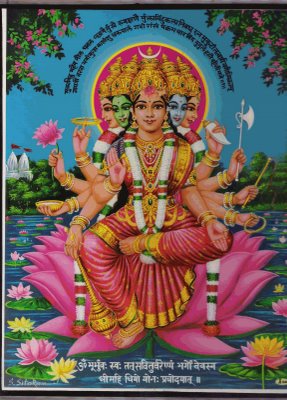
Gaayatree is a Devee also who removes ignorance and lets her Bhakt see the spiritual sunlight. She is depicted with five faces with different colors, carrying different things, with ten graceful eyes, sitting on a red lotus. Each of her five faces signifies a specific meaning such as ---
(1) Pearl Color - Pearls are collected from the sea from shells. These shells come to the shore of the sea with their eyes and mouth open. When it rains, the rain drops fall into their mouth and if at the time the rain drops fall into their mouth, the Swaati Nakshatra (star) is in the sky, they absorb its radiation into them, then the rain drops are converted into original pearls (as distinct from cultured Pearls). These original pearls are Divine in nature. Thus the first face of Gaayatree is of Pearl color, giving out the luster of Pearls representing brilliance.
(2) Coral Color - (bright red) Coral is one of the nine gems. The second face develops the principle of Nishchal Tattwa in the aspirants mind - still mind.
(3) Gold Color - Very bright both in color and quality. Mere seeing the gold and exposing ourselves into its luster promote good quality and external charm in the aspirant.
(4) Blue color - represents the Sky. Sea is also blue in color. Vishnu is also blue in color - Vishnu Tattwa. This face fosters the aspirant with all wealth and also Divine Grace from Naaraayan.
(5) White face -This face represents purity. It develops purity in the mind of the aspirant and also grants divine grace from Saraswatee - the goddess for wisdom.

Gayatri is the Aadi Shakti, initial power or prime power, which gives the movement, force or inspiration to both living and nonliving things. Gayatri Poojaa is done by chanting Gayatri Mantra, or by worshipping the Gayatri Yantra, or by conducting the Gayatri Anushthaan.
Picture of Gayatri Maa
This picture of Gayatri Maa is made on the basis of a Shlok from "Sharada Tilakam". Based on this Shlok, many pictures of Gayatri Maa were drawn and are available, but one picture which is very close to the description given in that Shlok is given here along with Shlok and its meaning. This Shlok is also the Dhyaan Shlok for invoking Gayatri before starting her Jap during Sandhyaa Vandan -
Muktaa Vidrum Hem Neel Deval Chhaayai Mukhais Tri-kshanai
Yuktaam Indu Kalaa Nibaddh Mukutaam Tatwaarth Varnaatmikam
Gayatri Varad Abhayaangush Kasaas Subram Kapaalam Gadaam
Shankham Chakram Atharavindaa Yugalam Hastair Vaahanteem Bhaje

I sing in praise of Gayatri, who has five faces of the colors of pearl, coral, gold, blue, and white, who has three eyes
Who has the crescent moon in the crown, who is of the form of the (24) letters, describing the Tattwa
Who shows Varad and Abhaya Mudraa in two hands and holds the Ankush, whip, the white skull, the Gadaa
The conch, the Chakra and the lotus (in the other eight hands)


This picture shows --
--The five faces of Gayatri - five parts of Gayatri Mantra
--The crescent Moon on the crown, the three eyes and the skull are symbolic of Shiv, the Destroyer
--The conch, Chakra, Gadaa, lotus, the Abhaya Mudraa denote Vishnu, the Protector
--The lotus seat is symbolic of Brahmaa, the Creator
--The Ankush and whip symbolize Kaalee, the Shakti

Thus, in short, (see also Why Gayatri Mantra is a Mahaa Mantra)
--Gayatri is symbolized as Sarv Devtaa Swaroop - Brahmaa, Vishnu and Shiv.
--Gayatri denotes the three Ved that is why she is called Ved Maataa.
--Gayatri is the extension of the primordial sound Aum.
--Gayatri denotes subjects as he plural, that is why even if an individual chants it, the benefit goes to humanity.
--Gayatri has 24 letters which denote 24 principles.
--This picture is for a Grihasth to meditate upon, a Brahmchaaree should always meditate upon her as a light.