Thursday, 30 June 2011

Introduction to Lakshmi - the Goddess of Wealth and Fortune


Draped in a red saree, bedecked with gold ornaments, seated on a lotus, pot in hand, flanked by white elephants, the image of Lakshmi adorns most Hindu homes and business establishments.
Lakshmi, also called Laxmi, is the goddess of wealth, fortune, power, luxury, beauty, fertility, and auspiciousness.  She holds the promise of material fulfillment and contentment.  She is described as restless, whimsical yet maternal, with her arms raised to bless and to grant her blessings.
Shri is the sacred name of Lakshmi.  Shri is written atop most documents and spoken before addressing a god, teacher holy man or any revered individual.  The word evokes grace, affluence abundance, auspiciousness and authority.  When the word is spoken or written an aura of holiness is established.  Whatever follows is imbued with divine blessing.  Just as the word “Om” is associated with the mystical side of life, Shri is associated with the material side of existence.

Lakshmi represents the beautiful and bountiful aspect of nature.  As Bhoodevi, the earth-goddess, she nurtures life; as Shreedevi, the goddess of fortune, she bestows power, pleasure and prosperity on those who deserve her grace.  To realize her, one must respect the laws of life and appreciate the wonders of existence.

Lakshmi’s Sacred Narrative; Prajapati Raises the Earth
In the beginning, there was water everywhere.  There was nothing to eat and nowhere to live.  Prajapati, the divine patriarch, father of the gods and demons saw the plight of his children and invoked Devi.
The goddess whispered into his ear, “The earth lies trapped under the water.  Raise it up.”
Prajapati took the form of a mighty boar called Emusha, plunged into the sea and found the earth-goddess Bhoodevi on the ocean floor.  Placing her on his snout, he gently raised her to the surface.
Prajapati then turned into Akupara, a giant turtle and offered Bhoodevi a seat on his back.


Shreedevi Favors Bali
Seated on the celestial turtle, the earth-goddess nurtured life in her bountiful arms.  She offered food and shelter to all. 
The devas, gods, admired her beauty; the asuras, demons, craved her wealth.  They fought many a battle over her.  Finally, under the leadership of Bali, the asuras emerged triumphant.
Impressed by Bali’s strength, the goddess came to him as Shreedevi and crowned him king of the earth.  She offered him a throne, a footstool and held a parasol over his head. 
Shreedevi’s sacred white elephants turned into clouds and sprinkled life-bestowing rain upon the earth, watering fields and pastures so that crops grew abundantly and cows gave plenty of milk.  Everyone was happy with Bali as their king.


Vishnu’s Three Steps
Power made Bali arrogant.  He declared, “The earth belongs to me; I can give anyone anything he desires.”
These words greatly disturbed the earth-goddess.  She belonged to no one and certainly not a commodity to be given to away as a gift.
Indra, leader of the devas, meanwhile, bereft of Shreedevi’s grace had been reduced to poverty.  He approached Bali and begged for some land.  To mock him, Bali pointed to Vamana the dwarf and said, “I shall give you as much land as this little one can cover in three strides.”  Vamana was no ordinary dwarf but rather an incarnation of Vishnu the Preserver. 

As soon as Bali said this, Vishnu began to grow in size, he turned into a giant who strode across and claimed all of Bali’s Kingdom in two steps.  With his third step Vishnu shoved Bali into the nether region.Vishnu thus wrested control of the earth for the gods.
The Fickle One”The gods may lack strength, but they are intelligent.  I shall go to them.”  So saying, Shreedevi turned away from Bali and went to the gods.  She blessed the gods with ruling majesty, material prosperity, physical health, bodily beauty and divine fortune.
Angry and bitter in defeat, the demons rasped, “Shreedevi is Chanchala, the fickle one.  Once she favored Bali, now she favors Indra.  She is faithful to none.”
“That is not true,” said the goddess, “I am eternally faithful to he who does not abuse my gifts.”

Vishnu’s Detachment
Vishnu, who had conquered the earth for the gods, let Indra become king.  “Don’t you want to be lord of the universe and enjoy the splendors of the cosmos?” asked Shreedevi.
“I desire nothing.  By defeating the demon Bali, I have done my duty.  I seek no reward for it.”
These words of Vishnu pleased Shreedevi.
Indra Angers Bhoodevi and Shreedevi
The goddess said, “He who takes good care of the earth-goddess Bhoodevi, wins the affection of Shreedevi, goddess of fortune and becomes king of the cosmos.”
But Indra did not heed her words.  Soon after being crowned king, the leader of the devas, he retired to the pleasure gardens.  There, he drank wine, enjoyed song and dance and neglected his royal duties.
The earth, left ungoverned was plundered.
Bhoodevi’s lamentation fell on deaf ears.  This made Shreedevi very angry.  She turned away from Indra.
Shreedevi Disappears
“Wealth and power corrupted the demon-king.  Now, pleasure and comfort has weakened the god-king.  Neither holds on to dharma for long.  Neither deserves my grace.”  So saying, the goddess dissolved herself in the ocean of milk.
Instantly a gloom descended upon the world: it no longer reverberated with song and dance.  Weapons lost their power, gems their luster, men their vigor.  Cows did not give milk, fields became barren, and trees bore neither flower nor fruit.  The cosmos became a desolate place bereft of joy and laughter.
Churning the Ocean of Milk
The goddess’s disappearance caused panic in the three worlds.
“We must bring her back,” said the gods.
“But how?” wondered the demons.
“By churning the ocean of milk,” said Vishnu.With Mandara, king of mountains, as the spindle and Akupara, king of turtles as the base, the devas and the asuras created the cosmic churn.  Using Vasuki, the king of the serpents as the churning rope, they began churning the ocean of milk.


Lakshmi rises
The churn twisted and turned, the ocean frothed and fumed, waves roared and spewed foam in every direction.  Eons passed.  Nothing emerged.  But the gods and demons were determined to bring the goddess back and continued to churn the great ocean.
Pleased by their efforts, the goddess finally emerged as a Lakshmi, the desirable one, in all her splendor.
Seated on a dew drenched Lotus, dressed in red silk, bedecked in gold, she was the very embodiment of affluence, abundance and auspiciousness.
As she rose, rasa, life giving sap, began flowing in every direction.  The earth palpated with life.  Joy filled the air.
The gods saluted her; the demons sang songs to her glory.
Sacred elephants who hold up the sky came from the eight quarters of the universe raised their trunks and consecrated her with life sustaining water.
Birth of Alaskshmi
Along with Lakshmi rose Alakshmi, the goddess of barrenness and misfortune from the churning of the ocean milk.  She was ugly with matted hair, sunken cheeks, shriveled breasts and coarse limbs.
Said the goddess, “Lakshmi will dwell where there is nobility and righteousness, cleanliness and beauty, virtue and compassion.  Alakshmi will dwell elsewhere, attracted by sloth, envy greed, lust and pride.”
And so it is that people who wish to keep Alakshmi away keep their houses clean, their bodies beautiful and their minds pure.
Gifts of Prosperity
With Lakshmi came a cow called Kamadhenu with enough milk to feed the world for all eternity, a wish fulfilling gem called Chantamani and a tree called Kalpataru that bore every flower and fruit desirable.  In her hand she held the basket of bounty: the Akshaya Patra overflowing with grain and gold.

Gifts of Pleasure
With Lakshmi appearance from the ocean of milk came Kama the delightful god of pleasure.  Riding his parrot surrounded by bees and butterflies, this handsome god raised his sugarcane bow and shot arrows dripping with desire into the heart of every being.  He roused the senses, excited the mind and inspired the heart.
With Kama came Priti and Rati, goddess of love and longing and Vasantathe lord of the spring.  Wherever they went flowers bloomed bees buzzed to welcome them with offerings of nectar and pollen.
Behind Lakshmi stood Rambha, the beautiful nymph who knew 64 ways to pleasure the senses and Sura, the goddess of intoxicants who could soothe tired nerves and enchant the mind with dreams.

Gifts of Power
Along with Lakshmi came the six tusked, white skinned elephant, Airavata and the seven-headed flying horse, Ucchaishrava.  The gods claimed the elephant, the demons claimed the horse.
The goddess also brought forth a throne, a crown, a footstool, a parasol, a fly-whisk, a cushion, a fan, a bow and a conch.  “These symbols of kingship,” she said, “will go to a worthy being, one who will use power to preserve and protect life.”
“Give them to me,” said Indra the king of gods.   “No you are too obsessed with pleasure,” said Lakshmi. “Give them to me,” said Bali King of demons. “No wealth corrupts you and makes you arrogant.”
Lakshmi sought someone who would not succumb to the allure of power, pleasure and prosperity; someone strong, wise and virtuous, capable of using force, charm and guile with discretion to uphold the laws of life.  She chose Vishnu.
Lakshmi Marries Vishnu
Lakshmi placed Vaijayanati, the fragrant garland of victory round Vishnu’s neck and made him her consort.  He became known as Shreenatha, beloved of fortune.
Vishnu placed Shreevasta, the symbol of Lakshmi on his chest.
Their abode, Vaikuntha, became the pivot of the universe.
Vishnu battled the forces of chaos and corruption and diligently performed his duties as guardian of the world, pleasing Lakshmi who rewarded him with her love and affection, tending to his every need as his devoted wife.

LAKSHMI

LAKSHMI

by Mantra & shlokas on Thursday, October 28, 2010 at 3:57pm


Real Name: Lakshmi-Sri
Occupation: Queen of the Hindu gods, goddess of love, fortune and fertility
Legal Status: Citizen of Nirvana
Identity: The general populace of Earth is unaware of the existence of Lakshmi except as a mythological character.
Other Aliases: Kamala, Shri, Shakti, Devi, Sita (mortal avatar), Armaiti (Persian name), Gong de Tian (Chinese name)
Place of Birth: Mount Himavat (modern Mount Everest in the Himalayas of Tibet)
Marital Status: Married

Known Relatives: Himavat (father), Menahka (mother), Parvati, Sarasvati, Ganga, Yamuna, Uma (sisters), Vishnu (husband), Padma (daughter), Kama (son), Brahma, Shiva, Agni, Yama, (brothers-in-law), Ganehsa, Skanda (nephews), Kali, Vach (nieces), Kartikeya (nephew, deceased),
Group Affiliations: The Hindu Gods
Base of Operations: Amaravati in the realm of Nirvana

First Appearance: (historical) "Pantheons of the Megaverse" by C.J. Carella, (recent) Thor I #301

History: Lakshmi is one of the Apsaras, a group of water-goddesses descended from the primal being known as Himavat, a member of the extra-dimensional race of beings known as the Devas, who were worshipped by the ancient Vedic tribes of Ancient India and later the modern Hindu religion. Himavat was the great snow-god of the Vedic pantheon, and the waters trickling from his peaks into rivers and ravines were protected by his daughters, the Apsaras.

The Apsaras were water-deities that helped carry the pious into heaven and had emerged from the sea during the deluge which covered the earth during the Earth's primeval past. Among them, the most revered were Ganga who protected the sacred Ganges river, Parvati, wife of Shiva and Lakshmi, wife of Vishnu, who had helped lead the Devas to victory against the Rakshasas, the eternal enemies of the Hindu gods. Before her marriage to Vishnu, Lakshmi had been wooed by Indra the thunder-god, but he displeased her by trying to control her and the rain she sent to earth

Lakshmi made her home in the celestial city of Vaikunthia in the heaven of Nirvana, considered the highest level of existence in the Hindu faith. She gave birth to a number of goddesses, including Padma, the lotus-goddess, and Kama, the love-god, who incinerated by Shiva but restored to life or replaced with the body of Krishna. In the early Vedic pantheon, Lakshmi had been revered as a goddess of love, but in the Hindu religion, she was worshipped as goddess of fortune and  prosperity , her former role as love-goddess taken over  by Ratri, the former goddess of night

Vishnu meanwhile assumed the role of seven mortal avatars on earth; Lakshmi lived through at least avatars with him as his true love. In the first, she was born as the mortal cow-maiden, Sita, wife of Vishnu as the hero, Rama, and entered exile with him when he abdicated the throne of Ayodha for his brother. She was kidnapped by Ravanna, one of the Rakshasas, and carried off to the island of Ceylon. Rama and his brothers obtained the help of King Sugriva and General Hanuman of the monkey-gods to invade Ceylon from which they had been exiled and built a bridge to invade the island to rescue Sita. Unfortunately, Sita was not honored by the people of Ayodhya for having lived among the Rakshasas, even against her will and Rama reluctantly sent her away. Sita gave birth to his sons, Kusa and Lava in exile, and as s, they eventually returned to Ayodhya and told the passionate story of their parents' life to Rama. He is so moved by their story that he and his followers allowed Sita to return. 

In another avatar, Lakshmi is born as Radha, again of poor parents, and became the beloved of  the hero Krishna, her foster-brother. Krishna was a major hero in the Hindu religion by slaying demons, monsters and enemies of the gods, and had several wives and lovers, but Radha was his favored bride. It was the body of Krishna who was mystically revived to restore Kama to life. Lakshmi later regained her true form and rejoined Vishnu in the heaven of the Hindu gods

After the Third Host of the Celestials, Lakshmi and her sisters Parvati and Sarasvati united with the mother-goddesses from all the pantheons of gods once worshipped or still worshipped on earth. This gathering included Frigga of the Asgardian gods and Hera of the Olympian gods. The Celestials and threatened to sever the gods connections to earth if they did not cease trafficking with mortals and had predicted to return in a thousand years to decide if humanity was fit to exist. Frigga had asked the wives of the god-kings of earth to locate twelve human beings of pure genetic potential to serve as prime examples of humanity when the Fourth Host of the Celestials should occur. The Hindu goddesses had succeeded in locating Jahahanel Patel of the Brahmin caste at the turn of the century to be their representative and concealed him in an underground location where he was attended by several minor Hindu goddesses. When the Fourth Host occurred, the supreme mother-goddess Gaea who was the ancestor of all the gods of earth presented these twelve examples known as the Young Gods. The Celestials voted in favor of earth in view of the Young Gods and departed Earth with them into outer space.

Height: 6' 0"Weight: 345 lbs.Eyes: BlueHair: BlackUnusual Physical Features: In her true godly form, Lakshmi has four arms.

Strength Level: Lakshmi possesses superhuman strength enabling her to lift (press) 75 tons under optimal conditions

Known Superhuman Powers: Lakshmi possesses the conventional physical attributes of the Devas or Hindu gods. Like all Devas, she is virtually immortal: she has not aged since reaching hood and cannot die by any conventional means. She is immune to all Earthly diseases and is resistant to conventional injury. If she were somehow wounded, her godly life force would enable her to recover with superhuman speed. It would take an injury of such magnitude that it dispersed a major portion of her bodily molecules to cause her a physical death. Even then, it might be possible for a god of significant power, such as Brahma, Vishnu or Shiva or for a number of Hindu gods of equal power working together to revive her. Lakshmi also possesses superhuman strength and her Deva metabolism provides her with far greater than human endurance in all physical activities. (Deva flesh and bone is about three times as dense as similar human tissue, contributing to the superhuman strength and weight of the Hindu gods

Lakshmi also possesses the ability to tap into her shakti, her primal female energies, in order to create feats of magic. She can travel between dimensions, bestow positive energies ("good luck") upon mortals, conjure lightning bolts and control the weather. She is considered the symbol of the womb, immortality and spiritual purity and was often called upon to insure fertility. She has the ability to send her life force through avatars or mortal forms, having been born as the goddess Sita in ancient times, and reincarnating herself through various forms. Lakshmi is considered among the most powerful goddesses in the Hindu pantheon.

Comments: This bio includes Lakshmi's appearances in the Marvel Universe. She only appears behind the scenes of the DC Universe.

King Bali and Goddess Lakshmi

The tale of King Bali and Goddess Lakshmi epitomizes the pious bond of Raksha Bandhan. Their legend is a famous example of how dedicated siblings can be to each other. This mythological story reflects on the pure bond of Rakhi which is full of love, compassion, trust, faith and loyalty.

As per the legend, Demon King Bali, the grandson of Prahlada was a true devotee of Lord Vishnu. With the Lord's blessings,he had become invincible in the battle field and managed to defeat all Devas. The entire heaven, especially Lord Indra, became apprehensive about his increasing strength. At last, Lord Vishnu disguised as Vamana (dwarf), arrived on earth, to rescue Indra and other Devas from their plight. King Bali had the reputation of being a generous and good king. Using this quality, Vamana asked for space which could be covered in three sides.Surely a dwarf could not cover much ground, thought the King, and agreed to his request. At this point, the dwarf changed into Vishnu and his three strides covered the Earth, the Skies and the whole Universe. As a result, Bali was sent to nether lands.

But we all know, Gods are ever generous and cannot see their true devotees suffer. So Lord Vishnu decided to protect Bali and brought him back from nether land. Bali was promised divine protection and immortality till the next aeon, when he will be crowned Indra. Lord Vishnu disguised himself, as Bali's doorman, and protected him from all dangers.
As a result, Vainkuntha was devoid of the Lord and Goddess Lakshmi became restless. She descended on earth as a Brahmin woman in an attempt to bring back her love. She told Bali, that her husband has gone away for a long errand and she needed a place to stay. King Bali welcomed her full heartedly and protected her as his own sister. Since the arrival of the Brahmin woman, i.e. , the Goddess herself the entire household of Bali was suddenly blooming with happiness, wealth, and harvest. 
Finally, on the day of Purnima in the month of Shravana, Goddess Lakshmi tied a thread of colored cotton on Bali's wrist and prayed for protection and happiness. Touched by her sincerity, Bali granted her the wish to ask for anything. Immediately, Goddess Lakshmi pointed at the gatekeeper and requested Bali to return her husband. Confused, Bali asked how a mere guardian can be the husband of such a virtuous lady ! It was then, both Lord Vishnu and Goddess Lakshmi revealed their true identities. Bali, being a virtuous man and a protective brother, requested the Lord to go back to Vaikuntha with the Goddess. But to keep his promise, every year, the Lord came back for about four months during the monsoon season.
In order to commemorate Bali's devotion to the lord and his sister, the Goddess this festival is also known as Baleva. Since then, brothers all over the world follow the tradition of inviting their sisters for tying the thread of love and celebrating Raksha Bandhan.

Great people are always humble

Lord Raama, the paramaathma, was ofcourse the greatest warrior ever. Lord Krishna in Bhagavadgita remarks “I am Raama among warriors”. He learnt all the Shastras and unparalled Dhanurvidya under the guidance of the great Vasishtha. He was also given super-human powers like bala, ati bala by the great Vishwamithra, the Rishi of Gayathri manthra. Vishwamithra maharshi also taught him all the secret astras that ever existed, which only he in this whole universe knew (he originally learnt it from Lord Shiva). In addition to these, Agasthya mahamuni gave him many additional powers.A few glimpses of Lord Raama’s valour:
  1. With one arrow Raama kills taataki, the mighty raakshasi.
  2. With two simultaneous arrows he kills subaahu and throws Maaricha seven seas away.
  3. Effortlessly lifts the Shiva dhanush, which was pulled to the court by around 50000 well built people.
  4. Raama kills Khara, Dhushana, their 1000 brothers and their army in 14 minutes single handed.
Despite being such a great warrior, he never displayed in strength on his own to show others. The anger on the samudra stands as a good example for this quality of Raama:
Raavana gives 30 days time to sita maata to decide if she will marry him, else will kill her. Bharata took word from Raama saying that if he does’nt return on the next moment of 14 yrs of aranyavaas, then he will sacrifice himself. Raama and his army reaches the shores of ocean with barely 30 days in hand. They have to cross the ocean, defeat Ravana & his army, take sita back to ayodhya in around 30 days time. With such a press for time and given the strength of Raama, Lakshmana suggests Raama not to spend time asking ocean God for way, but to order him.
What Raama does is unbelievable. Though he had the strength and power to control the ocean God, he did not do it. He did penance on the shores of the ocean for 3 long days to give them a way. Finally after 3 days Raama gets angry on the ocean and to make remember his duty, aims an astra at him and immediately ocean God appears and suggests a way of crossing him…


Morals in the Story:
  1. We, for our small petty achievements in life, are very proud (ahankaar) and given a chance, display our strengths. The way of great people is quite different as shown by Lord Raama.
  2. One must never use the strength or powers just because they exist with him, but judiciously use them for the benefit of everyone, upliftment of Dharma.
Message:
  1. Controlling one’s ahankaar is one the most difficult things. If it is controlled we will see a more peaceful world.
  2. Always people who are humble and obedient are only respected by others. If Lord Raama Himself is so humble, as mere normal human beings imagine how much obedient we must be to our elders and parents.

Story of Shiva and Vishnu

“There are two mahaa-phala daayaka Vrukshas. One by the name Vaasudeva and the other by the name Vaamadeva. They differ only in their sumas (flowers) (‘su’ is replaced by ‘ma’ in their names), but both give the same phalas (fruits, which is moksham)”. It is also often said, “How much one does not see the difference between Shiva and Vishnu, that much his aayu will increase”.

One day, when Lakshmi and Vishnu were together in vihaaram, Lakshmi sees Ucchaishravam, her brother, the horse of Revanta who is the son of Surya. Engrossed in seeing her brother, she does not reply to the repeated calls of Vishnu.

Seeing her attraction, Vishnu gives her shaapam to go to Bhulokam in the form of a horse and come back to Vaikuntam only after getting a son equal to Himself! She comes to Bhuloka to experience the shaapam and realizing that none other than her brother, Shiva can help her calm Vishnu, she immediately does a tapas for Him and Shiva appears to save her soodari. Lakshmi says “You and Vishnu are both same, the Paramaatma. Please help me!”. Shiva says “Soodari! How do you know that we both are same? All learned people know that. Who told you?”. Lakshmi says, “Once Mahavishnu Himself told me this. Seeing Him in deep Daiva-dhyaanam, I asked Him “During Samudramanthanam, I thought you were the greatest of all and hence chose you. Devaadideva! Who is better than you that you are in dhyaanam of Him?”.

Mahavishnu replied “I am doing Shankara-dhyaanam. He is Eshwara. He is the same as Me. All learned people know that. If someone is my devotee but still hates Shiva, he will fall into naraka”.

Saying this, She asks Shiva to pursuade Vishnu to bless Her with a child. Shiva sends Chitrarupa as a duta to convince Vishnu. Vishnu immediately accepts and comes to Bhuloka and blesses Lakshmi with Ekaveera, who is equal to Vishnu Himself. From Ekaveera came forth the Haihaya dynasty, of which the most noted king is Kartavirya Arjuna (Ekaveera’s grandson).

Ganesh Chaturthi

By

Sri Swami Sivananda

SALUTATIONS to Lord Ganesha who is Brahman Himself, who is the Supreme Lord, who is the energy of Lord Shiva, who is the source of all bliss, and who is the bestower of all virtuous qualities and success in all undertakings.
Mushikavaahana modaka hastha,
Chaamara karna vilambitha sutra,
Vaamana rupa maheshwara putra,
Vighna vinaayaka paada namasthe
MEANING: "O Lord Vinayaka! the remover of all obstacles, the son of Lord Shiva, with a form which is very short, with mouse as Thy vehicle, with sweet pudding in hand, with wide ears and long hanging trunk, I prostrate at Thy lotus-like Feet!"
Ganesh Chaturthi is one of the most popular of Hindu festivals. This is the birthday of Lord Ganesha. It is the day most sacred to Lord Ganesha. It falls on the 4th day of the bright fortnight of Bhadrapada (August-September). It is observed throughout India, as well as by devoted Hindus in all parts of the world.
Clay figures of the Deity are made and after being worshipped for two days, or in some cases ten days, they are thrown into water.
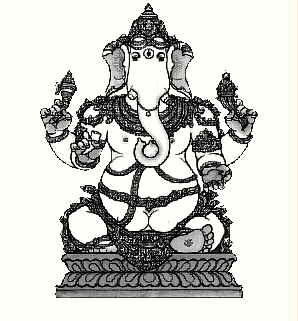
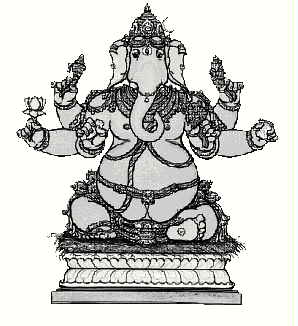
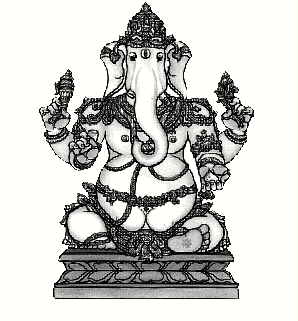
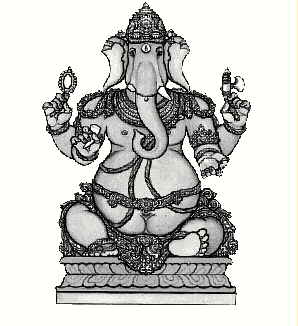
Lord Ganesha is the elephant-headed God. He is worshipped first in any prayers. His Names are repeated first before any auspicious work is begun, before any kind of worship is begun.
He is the Lord of power and wisdom. He is the eldest son of Lord Shiva and the elder brother of Skanda or Kartikeya. He is the energy of Lord Shiva and so He is called the son of Shankar and Umadevi. By worshipping Lord Ganesha mothers hope to earn for their sons the sterling virtues of Ganesha.
The following story is narrated about His birth and how He came to have the head of an elephant:
Once upon a time, the Goddess Gauri (consort of Lord Shiva), while bathing, created Ganesha as a pure white being out of the mud of Her Body and placed Him at the entrance of the house. She told Him not to allow anyone to enter while she went inside for a bath. Lord Shiva Himself was returning home quite thirsty and was stopped by Ganesha at the gate. Shiva became angry and cut off Ganesha's head as He thought Ganesha was an outsider.
When Gauri came to know of this she was sorely grieved. To console her grief, Shiva ordered His servants to cut off and bring to Him the head of any creature that might be sleeping with its head facing north. The servants went on their mission and found only an elephant in that position. The sacrifice was thus made and the elephant's head was brought before Shiva. The Lord then joined the elephant's head onto the body of Ganesha.
Lord Shiva made His son worthy of worship at the beginning of all undertakings, marriages, expeditions, studies, etc. He ordained that the annual worship of Ganesha should take place on the 4th day of the bright half of Bhadrapada.
Without the Grace of Sri Ganesha and His help nothing whatsoever can be achieved. No action can be undertaken without His support, Grace or blessing.
In his first lesson in the alphabet a Maharashtrian child is initiated into the Mantra of Lord Ganesha, Om Sri Ganeshaya Namah. Only then is the alphabet taught.
The following are some of the common Names of Lord Ganesha: Dhoomraketu, Sumukha, Ekadantha, Gajakarnaka, Lambodara, Vignaraja, Ganadhyaksha, Phalachandra, Gajanana, Vinayaka, Vakratunda, Siddhivinayaka, Surpakarna, Heramba, Skandapurvaja, Kapila and Vigneshwara. He is also known by many as Maha-Ganapathi.
His Mantra is Om Gung Ganapathaye Namah. Spiritual aspirants who worship Ganesha as their tutelary Deity repeat this Mantra or Om Sri Ganeshaya Namah.
The devotees of Ganesha also do Japa of the Ganesha Gayatri Mantra. This is as follows.
Tat purushaaya vidmahe
Vakratundaaya dheemahi
Tanno dhanti prachodayaat.
Lord Ganesha is an embodiment of wisdom and bliss. He is the Lord of Brahmacharins. He is foremost amongst the celibates.
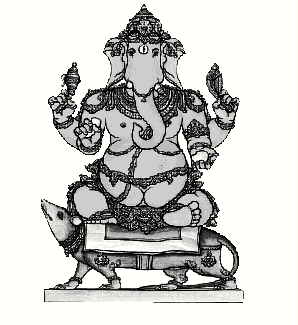
He has as his vehicle a small mouse. He is the presiding Deity of the Muladhara Chakra, the psychic centre in the body in which the Kundalini Shakti resides.
He is the Lord who removes all obstacles on the path of the spiritual aspirant, and bestows upon him worldly as well as spiritual success. Hence He is called Vigna Vinayaka. His Bija Akshara (root syllable) is Gung, pronounced to rhyme with the English word "sung". He is the Lord of harmony and peace.
Lord Ganesha represents Om or the Pranava, which is the chief Mantra among the Hindus. Nothing can be done without uttering it. This explains the practice of invoking Ganesha before beginning any rite or undertaking any project. His two feet represent the power of knowledge and the power of action. The elephant head is significant in that it is the only figure in nature that has the form of the symbol for Om.
The significance of riding on a mouse is the complete conquest over egoism. The holding of the ankusha represents His rulership of the world. It is the emblem of divine Royalty.
Ganesha is the first God. Riding on a mouse, one of nature's smallest creatures and having the head of an elephant, the biggest of all animals, denotes that Ganesha is the creator of all creatures. Elephants are very wise animals; this indicates that Lord Ganesha is an embodiment of wisdom. It also denotes the process of evolution--the mouse gradually evolves into an elephant and finally becomes a man. This is why Ganesha has a human body, an elephant's head and a mouse as His vehicle. This is the symbolic philosophy of His form.
He is the Lord of Ganas or groups, for instance groups of elements, groups of senses, etc. He is the head of the followers of Shiva or the celestial servants of Lord Shiva.
The Vaishnavas also worship Lord Ganesha. They have given Him the name of Tumbikkai Alwar which means the divinity with the proboscis (the elephant's trunk).
Lord Ganesha's two powers are the Kundalini and the Vallabha or power of love.
He is very fond of sweet pudding or balls of rice flour with a sweet core. On one of His birthdays He was going around house to house accepting the offerings of sweet puddings. Having eaten a good number of these, He set out moving on His mouse at night. Suddenly the mouse stumbled--it had seen a snake and became frightened--with the result that Ganesha fell down. His stomach burst open and all the sweet puddings came out. But Ganesha stuffed them back into His stomach and, catching hold of the snake, tied it around His belly.
Seeing all this, the moon in the sky had a hearty laugh. This unseemly behaviour of the moon annoyed Him immensely and so he pulled out one of His tusks and hurled it against the moon, and cursed that no one should look at the moon on the Ganesh Chaturthi day. If anyone does, he will surely earn a bad name, censure or ill-repute. However, if by mistake someone does happen to look at the moon on this day, then the only way he can be freed from the curse is by repeating or listening to the story of how Lord Krishna cleared His character regarding the Syamantaka jewel. This story is quoted in the Srimad Bhagavatam. Lord Ganesha was pleased to ordain thus. Glory to Lord Ganesha! How kind and merciful He is unto His devotees!
Ganesha and His brother Lord Subramanya once had a dispute as to who was the elder of the two. The matter was referred to Lord Shiva for final decision. Shiva decided that whoever would make a tour of the whole world and come back first to the starting point had the right to be the elder. Subramanya flew off at once on his vehicle, the peacock, to make a circuit of the world. But the wise Ganesha went, in loving worshipfulness, around His divine parents and asked for the prize of His victory.
Lord Shiva said, "Beloved and wise Ganesha! But how can I give you the prize; you did not go around the world?"
Ganesha replied, "No, but I have gone around my parents. My parents represent the entire manifested universe!"
Thus the dispute was settled in favour of Lord Ganesha, who was thereafter acknowledged as the elder of the two brothers. Mother Parvati also gave Him a fruit as a prize for this victory.
In the Ganapathi Upanishad, Ganesha is identified with the Supreme Self. The legends that are connected with Lord Ganesha are recorded in the Ganesha Khanda of the Brahma Vivartha Purana.
On the Ganesh Chaturthi day, meditate on the stories connected with Lord Ganesha early in the morning, during the Brahmamuhurta period. Then, after taking a bath, go to the temple and do the prayers of Lord Ganesha. Offer Him some coconut and sweet pudding. Pray with faith and devotion that He may remove all the obstacles that you experience on the spiritual path. Worship Him at home, too. You can get the assistance of a pundit. Have an image of Lord Ganesha in your house. Feel His Presence in it.
Don't forget not to look at the moon on that day; remember that it behaved unbecomingly towards the Lord. This really means avoid the company of all those who have no faith in God, and who deride God, your Guru and religion, from this very day.
Take fresh spiritual resolves and pray to Lord Ganesha for inner spiritual strength to attain success in all your undertakings.
May the blessings of Sri Ganesha be upon you all! May He remove all the obstacles that stand in your spiritual path! May He bestow on you all material prosperity as well as liberation!

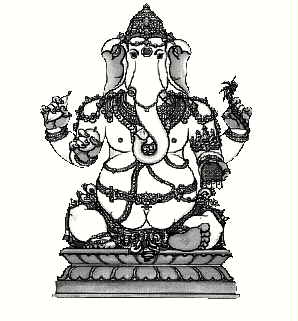
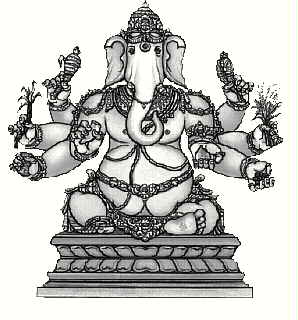
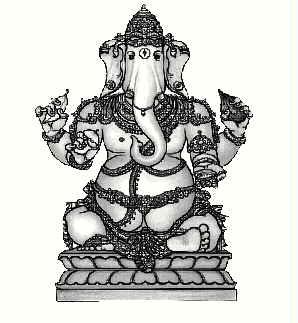
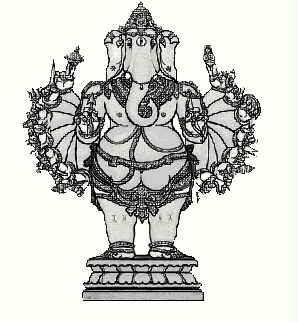
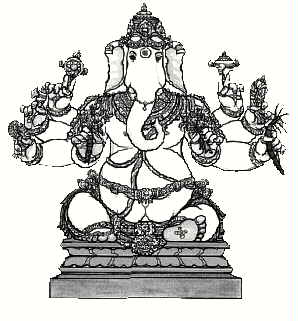
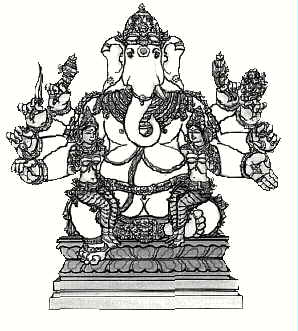
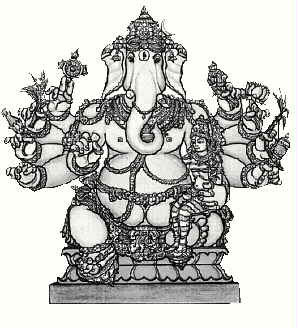
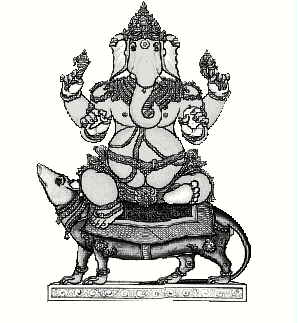
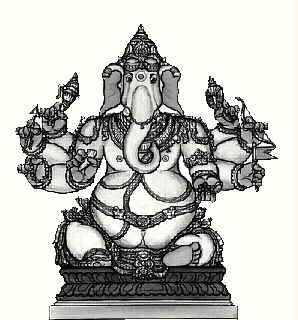
32 Forms of God Ganesh

1
ganesh01g_epsBala Ganapati
Bala Ganapati is "the Childlike" God of golden hue. In His hands He holds a banana, mango, sugar cane and jackfruit, all representing the earth's abundance and fertility. His trunk garners His favorite sweet, the modaka.


2
ganesh02g_epsTaruna Ganapati
Eight-armed, Taruna Ganapati, "the Youthful," holds a noose and goad, modaka, wood apple, rose apple, His broken tusk, a sprig of paddy and a sugar cane stalk. His brilliant red color reflects the blossoming of youth.


3
ganesh03g_epsBhakti Ganapati
Shining like the full moon during harvest season and garlanded with flowers, Bhakti Ganapati, dear to devotees, is indeed pleasant to look upon. He holds a banana, a mango, coconut and a bowl of sweet payasa pudding.


4
ganesh04g_epsVira Ganapati
The "Valiant Warrior," Vira Ganapati, assumes a commanding pose. His 16 arms bristle with weapons, symbols of mind powers: a goad, discus, bow, arrow, sword, shield, spear, mace, a battleaxe, a trident and more.


5
ganesh05g_epsShakti Ganapati
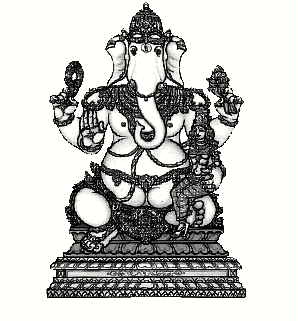
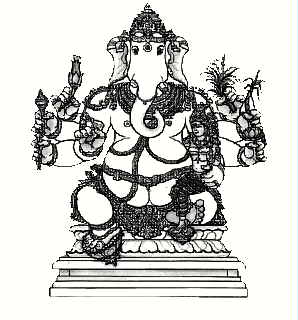
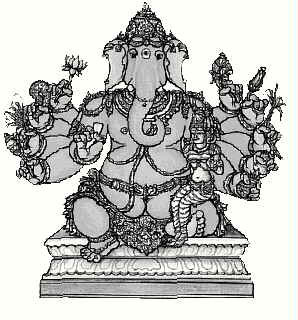
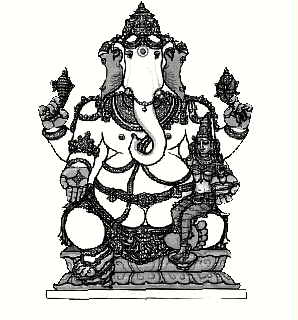
Four-armed and seated with one of His shaktis on His knee, Shakti Ganapati, "the Powerful," of orange-red hue, guards the householder. He holds a garland, noose and goad, and bestows blessings with the abhaya mudra.


6
ganesh06g_epsDvija Ganapati
Four-headed Dvija Ganapati, "the Twice-born," is moon-like in color. Holding a noose, a goad, an ola leaf scripture, a staff, water vessel and a his japa beads, He reminds one and all of the urgency for disciplined striving.


7
ganesh07g_epsSiddhi Ganapati
Golden-yellow Siddhi Ganapati, "the Accomplished," is the epitome of achievement and self-mastery. He sits comfortably holding a bouquet of flowers, an axe, mango, sugar cane and, in His trunk, a tasty sesame sweet.


8
ganesh08g_epsUcchhishta Ganapati
Ucchhishta Ganapati is "Lord of Blessed Offerings" and guardian of culture. Of blue complexion and six-armed, He sits with His Shakti, holding a vina, pomegranate, blue lotus flower, japa mala and a sprig of fresh paddy.


9
ganesh09g_epsVighna Ganapati
Vighna Ganapati, "Lord of Obstacles," is of brilliant gold hue and bedecked in jewels. His eight arms hold a noose and goad, tusk and modaka, conch and discus, a bouquet of flowers, sugar cane, flower arrow and an axe.


10
ganesh10g_epsKshipra Ganapati
Handsome, red-hued Kshipra Ganapati, "Quick-acting" giver of boons, displays His broken tusk, a noose, goad and a sprig of the kalpavriksha (wish-fulfilling) tree. In His uplifted trunk He holds a tiny pot of precious jewels.


11
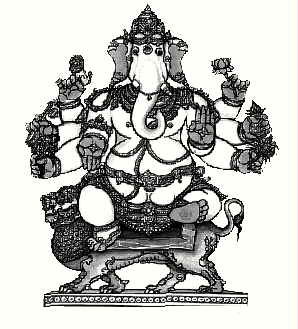
ganesh11g_epsHeramba Ganapati
Five-faced, white in color, Heramba Ganapati, "Protector of the Weak," rides a big lion. He extends the gestures of protection and blessing while holding a noose, japa beads, axe, hammer, tusk, garland, fruit and modaka.


12
ganesh12g_epsLakshmi Ganapati
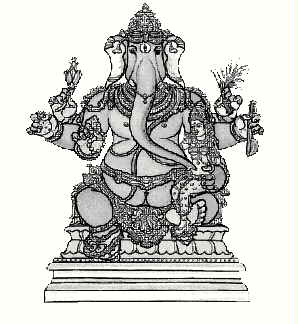
Lakshmi Ganapati, pure white giver of success, sits flanked by Wisdom and Achievement. Gesturing varada mudra, He holds a green parrot, a pomegranate, sword, goad, noose, sprig of kalpavriksha and a water vessel.


13
ganesh13g_epsMaha Ganapati
Accompanied by one of His shaktis, "the Great," Maha Ganapati, is red-complexioned and three-eyed. He holds His tusk, a pomegranate, blue lily, sugar-cane bow, discus, noose, lotus, paddy sprig, mace and a pot of gems.


14
ganesh14g_epsVijaya Ganapati
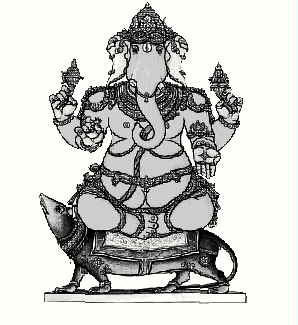
Four-armed, of red hue and riding His resourceful mushika, Vijaya Ganapati is "the Victorious" bestower of success. His insignia are the broken tusk, elephant goad, a noose and a lucious golden mango, His favorite fruit.


15
ganesh15g_epsNritya Ganapati
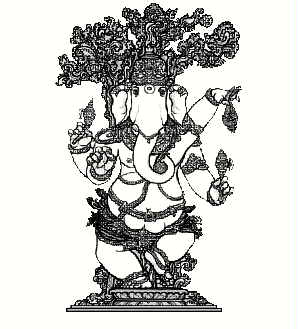
The happy "Dancer," Nritya Ganapati, is four-armed and golden, with rings on His fingers, holding a tusk, goad, noose and modaka sweet. He prances under the kalpavriksha tree, epitomizing exuberant activity and joy.


16
ganesh16g_epsUrdhva Ganapati
Seated with one of His shaktis on His left knee, Urdhva Ganapati is "the Elevated" Lord of golden hue. In His six hands He holds a sprig of paddy, a lotus, the sugar cane bow, an arrow, His ivory tusk and a blue water lily.


17
ganesh17g_epsEkakshara Ganapati
Ekakshara, of "Single-Syllable" (gam), is three-eyed, of red complexion and attire. Crescent moon on His crown, He sits in lotus pose upon Mushika, offers the boon-giving gesture and holds a pomegranate, noose and goad.


18
ganesh18g_epsVarada Ganapati
Varada Ganapati, "the Boon-Giver with prominent third eye of wisdom, holds a dish of honey, the noose and goad and encloses a pot of jewels in His trunk. His shakti is at His side, and the crescent moon adorns His crown.


19
ganesh19g_epsTryakshara Ganapati
Tryakshara Ganapati, "the Lord of Three Letters" (A-U-M), is gold in color and has fly whisks in His big floppy ears. He carries the broken tusk, goad, noose and mango and is often seen grasping a sweet modaka in His trunk.


20
ganesh20g_epsKshipra Prasada Ganapati
Kshipra Prasada Ganapati, "the Quick Rewarder," presides from a kusha-grass throne. His big belly symbolizes the manifest universe. He holds a noose, goad, tusk, lotus, pomegranate and a twig of the wish-fulfilling tree.


21
ganesh21g_epsHaridra Ganapati
Haridra Ganapati, the golden one dressed in bright yellow vestments, sits calmly on a posh, regal throne. Along with His tusk and a modaka, He wields a noose to hold devotees close and a sharp goad to spur them onward.


22
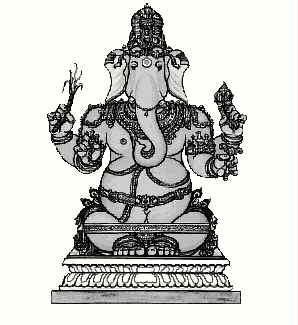
ganesh22g_epsEkadanta Ganapati
Ekadanta, of "Single Tusk," is distinguished by His blue color and sizeable belly. The attributes of this murti are an axe for cutting the bonds of ignorance, prayer beads for japa, a laddu sweet and the broken right tusk.


23
ganesh23g_epsSrishti Ganapati
Riding on His docile and friendly mouse, Srishti Ganapati is the lord of happy "Manifestation." This active God, of red complexion, holds His noose a goad, a perfect mango, and His tusk, representing selfless sacrifice.


24
ganesh24g_epsUddanda Ganapati
Uddanda Ganapati is the bold "Enforcer of Dharma," the laws of being. His ten hands hold a pot of gems, a blue lily, sugar cane, a mace, lotus flower, sprig of paddy, a pomegranate, noose, garland and His broken tusk.


25
ganesh25g_epsRinamochana Ganapati
Rinamochana Ganapati is humanity's liberator from guilt and bondage. His figure of alabaster skin is apparelled in red silks. He bears a noose and a goad, His milk-white tusk and a favorite fruit, the rose apple.


26
ganesh26g_epsDhundhi Ganapati
Red-hued Dhundhi Ganapati, "the Sought After," holds a strand of rudraksha beads, His broken tusk, an axe and a small pot of precious gems thought to represent the treasury of awakenings He saves for all ardent devotees.


27
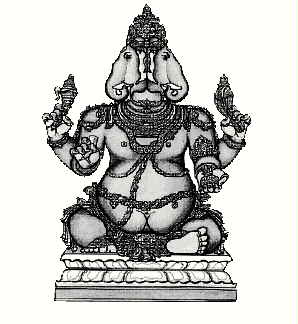
ganesh27g_epsDvimukha Ganapati
Dvimukha Ganapati, called Janus by the Romans, with two divergent faces, sees in all directions. His blue-green form is dressed in red silk. He wears a bejeweled crown and holds a noose, goad, His tusk and a pot of gems.


28
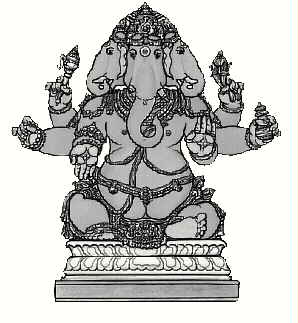
ganesh28g_epsTrimukha Ganapati
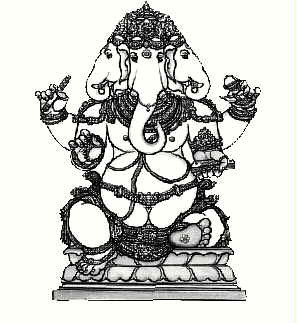
Trimukha Ganapati, the contemplative "three-faced" Lord of red hue, sits on a golden lotus, telling His beads, holding a noose, goad and vessel of nectar. He gestures protection with a right hand and blessings with a left.


29
ganesh29g_epsSinha Ganapati
Sinha Ganapati, white in color, rides a lion and displays another lion in one hand, symbolizing strength and fearlessness. He also holds a kalpavriksha sprig, the vina, a lotus blossom, flower bouquet and a pot of jewels.


30
ganesh30g_epsYoga Ganapati
Yoga Ganapati is absorbed in mantra japa, His knees strapped in meditative pose, hands holding a yoga staff, sugar cane stalk, a noose and prayer beads. His color is like the morning sun. Blue garments adorn His form.


31
ganesh31g_epsDurga Ganapati
Durga Ganapati, the "Invincible," waves the flag of victory over darkness. This splendid murti is of deep gold hue, dressed in red, holding a bow and arrow, noose and goad, prayer beads, broken tusk and a rose apple.

32ganesh32g_eps
Sankatahara Ganapati
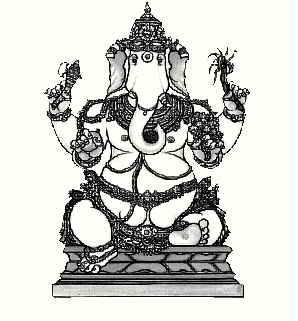
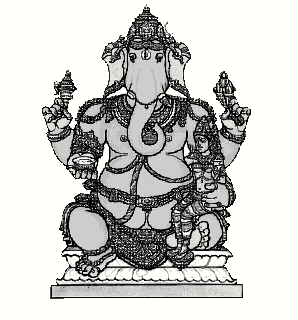
Sankatahara Ganapati, "the Dispeller of Sorrow," is of sunlike hue, dressed in blue, and seated on a red lotus flower. He holds a bowl of pudding, a goad and a noose while gesturing the boon-granting varada mudra.